
HealthyPa · Lung Health Guide
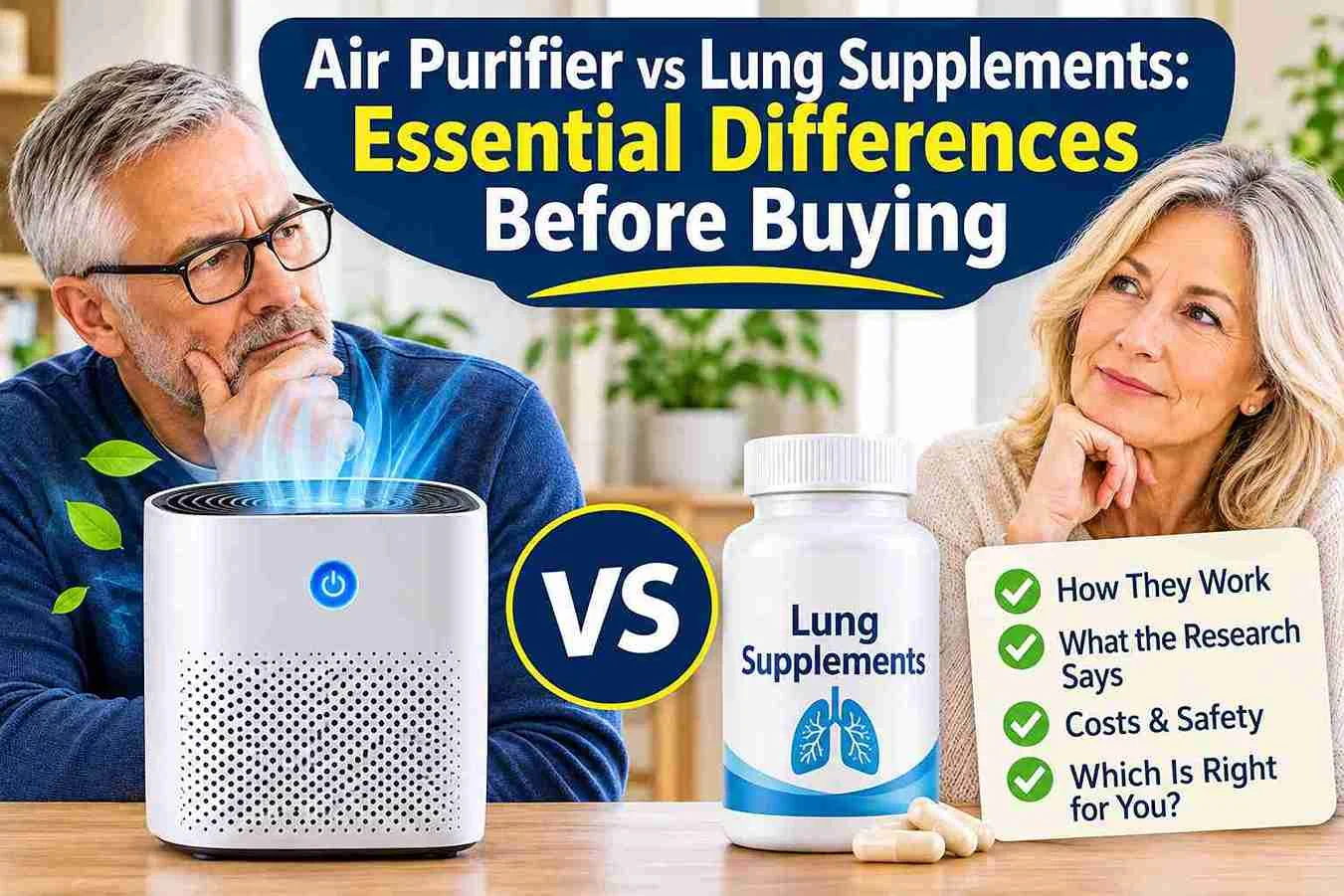
One cleans the air around you. The other provides ingredients you swallow. Understand the important differences between air filtration and lung supplements before deciding where your money is best spent.
If you are concerned about your breathing, indoor pollution or maintaining healthy lungs as you get older, you may have come across two very different options: buying an air purifier or trying a lung health supplement.
Both are marketed as ways to support respiratory wellness, but they do completely different jobs. An air purifier works outside your body by filtering certain airborne particles. A supplement works through the ingredients you consume, and any benefit depends on the formula, dosage, your nutritional needs and the available research.
That distinction matters. If your main concern is dust, pollen, smoke or airborne particles inside your home, a properly sized HEPA air purifier addresses the environmental problem directly. If you are considering a supplement such as Lungora, you need to look much more closely at its ingredients and whether there is reliable evidence that the finished product improves breathing.
Neither option should be considered a treatment for asthma, COPD or another respiratory condition.
Quick answer: Air purifier or lung supplement?
Choose an appropriately sized HEPA air purifier if your priority is reducing airborne particles in your home. It physically filters the air passing through its system.
Consider a lung supplement only as an optional nutritional product after checking its ingredients, doses, safety and evidence. A supplement cannot remove smoke, dust or allergens from your room.
For many households, reducing pollution sources, improving ventilation and using suitable filtration are more practical first steps than buying an unproven respiratory supplement.
On this page
- Understanding the fundamental difference
- How HEPA air purifiers work
- How lung supplements work
- Air purifier vs lung supplements comparison
- What scientific research actually shows
- Is Lungora worth considering?
- Which option might suit your needs?
- What to check before buying an air purifier
- Supplement safety and medical considerations
- Before-you-buy checklist
- Frequently asked questions
1. Understanding the Fundamental Difference
The easiest way to understand this comparison is to consider where each option works.
An air purifier treats the environment around you. It draws room air through a filter, captures certain pollutants and releases filtered air back into the room. Depending on its filtration system, it may help reduce airborne dust, pollen, smoke particles and other contaminants.
A lung supplement is an oral product containing ingredients such as vitamins, minerals, plant extracts or other compounds. These ingredients are intended to provide nutritional or biological support inside the body.
One is an environmental intervention. The other is a nutritional intervention.
For example, imagine someone living in a home where smoke from nearby traffic regularly enters through open windows. A HEPA purifier with an appropriate clean air delivery rate may help reduce some of the particles circulating indoors.
Taking a capsule containing antioxidants does not remove those particles from the room. Similarly, a purifier cannot correct a nutritional deficiency.
These are separate problems requiring separate approaches.
Why this distinction matters after 40
As people get older, they may become more conscious of respiratory health, especially if they have a history of smoking, allergies or exposure to workplace dust.
It is tempting to look for a single product that promises broad lung protection. However, good respiratory health depends on several factors, including avoiding tobacco smoke, limiting harmful exposures, managing existing medical conditions and maintaining general health.
Spending money on the wrong type of product can leave the original problem untouched.
2. How HEPA Air Purifiers Work
A portable air purifier generally contains a fan and one or more filters. The fan pulls air into the unit, passes it through the filtration system and circulates the treated air back into the room.
Many models use a high-efficiency particulate air (HEPA) filter designed to capture very small airborne particles.
What can a HEPA filter capture?
Depending on the device, its design and how it is operated, HEPA filtration can help remove airborne particles such as:
- Household dust and fine particles.
- Pollen from trees, grass and flowers.
- Some pet dander and airborne allergens.
- Particles associated with tobacco smoke.
- Some airborne mold spores.
- Some particles carrying infectious microorganisms.
- Fine particulate pollution, including PM2.5.
It is important to understand that capturing airborne particles does not mean eliminating every source of pollution. An air purifier will not remove all gases, chemicals or pollutants simply because its packaging says HEPA.
What about odors and chemical pollutants?
HEPA filters are designed primarily for particles, not gases.
If you are concerned about cooking odors, smoke-related gases or volatile organic compounds (VOCs), look for a unit that also contains an activated carbon filter or another suitable gas-adsorption system.
The amount and quality of carbon material matter. A very thin carbon-coated filter may have limited capacity for removing gases.
The US Environmental Protection Agency explains these differences in its Guide to Air Cleaners in the Home.
Why room size matters
Buying a powerful-looking purifier does not guarantee good performance in every room.
One of the most useful specifications to examine is the Clean Air Delivery Rate (CADR). This measures the volume of filtered air a purifier delivers for particular particle categories.
A higher CADR generally means the machine can filter more air and serve a larger room, assuming other conditions are comparable.
A small purifier designed for a bedroom may struggle to clean the air effectively in a large open-plan living area.
Do air purifiers improve respiratory health?
There is research suggesting that reducing indoor particle exposure can produce measurable health benefits in some circumstances. Studies involving portable HEPA filtration have reported modest improvements in certain respiratory and cardiovascular outcomes.
However, results vary, and improvements are not guaranteed to be noticeable. An air purifier should be viewed as an additional indoor air-quality measure rather than a treatment for lung disease.
3. How Lung Health Supplements Work
Lung supplements take a different approach. Rather than removing environmental pollutants, they provide nutrients or other compounds that may have biological functions within the body.
Common ingredients in respiratory wellness formulas include:
Vitamin D
Vitamin D contributes to normal immune function, muscle function and bone health. Deficiency is a recognized nutritional concern, and research has examined whether vitamin D supplementation can benefit particular groups of people with respiratory conditions.
However, taking additional vitamin D does not automatically improve breathing in someone who already has adequate levels. The potential benefit depends on the person’s nutritional status, health condition and appropriate dosage.
Vitamin C
Vitamin C is an antioxidant that contributes to normal immune function and protects cells from oxidative stress.
It is found naturally in foods such as oranges, berries, peppers and broccoli. Although vitamin C has important nutritional functions, evidence does not establish that taking large doses will cleanse the lungs or reverse damage caused by smoking.
N-acetylcysteine (NAC)
NAC is a compound used in certain medical and respiratory contexts. It is involved in glutathione production and has mucolytic properties, meaning it can help break down mucus.
Research has investigated NAC in people with chronic bronchitis and COPD, but results depend on the population, dosage and treatment context. A supplement sold for general lung wellness should not be assumed to provide the same effects as a studied medical intervention.
Coenzyme Q10
CoQ10 plays a role in cellular energy production and has antioxidant properties. It appears in several wellness supplements, including Lungora.
Its biological function does not establish that taking a particular CoQ10-containing supplement will increase oxygen levels or improve lung capacity.
Turmeric and other botanical ingredients
Turmeric contains curcuminoids, compounds that have been studied for their potential anti-inflammatory and antioxidant properties.
Other respiratory wellness formulas may contain mullein, ginger, quercetin or bromelain.
Some of these ingredients have interesting preliminary research, but traditional use, laboratory findings and human clinical results are not interchangeable.
The most important question is whether the actual supplement contains an appropriate quantity of an ingredient in a form that has been studied for the outcome being advertised.
Important distinction
Evidence that an individual ingredient has a biological function does not establish that a finished commercial supplement improves breathing.
Look for studies involving the actual formula, dosage and intended population before accepting strong product claims.
4. Air Purifier vs Lung Supplements: Side-by-Side Comparison
Here is a practical comparison of what each option can and cannot reasonably offer.
| Factor | HEPA air purifier | Lung supplements |
|---|---|---|
| Primary purpose | Reduce certain airborne pollutants indoors. | Provide nutrients or other biologically active ingredients. |
| Where it works | In the surrounding environment. | Inside the body after consumption. |
| Dust and pollen | Can capture airborne particles. | Cannot remove particles from the air. |
| Smoke particles | Suitable HEPA filtration can reduce airborne particles. | Cannot remove smoke particles from the environment. |
| Nutritional deficiencies | Does not correct deficiencies. | May help address specific deficiencies when appropriately formulated. |
| Evidence | Established physical filtration performance; health benefits vary. | Varies by ingredient, dose, condition and finished formula. |
| Ongoing costs | Electricity and replacement filters. | Recurring supplement purchases. |
| Maintenance | Filter cleaning or replacement as instructed. | Follow dosage and safety instructions. |
| Medication interactions | Generally not a direct medication interaction concern. | Possible, depending on ingredients. |
| Can treat COPD or asthma? | No. May help reduce certain indoor exposures. | No. Commercial wellness supplements are not replacements for prescribed treatment. |
| Best suited to | People wanting to reduce indoor airborne particles. | People with a specific nutritional reason to consider supplementation. |
The comparison shows why choosing one over the other is not always appropriate. They address different concerns, and neither should be expected to solve a problem outside its intended function.
5. What Does Scientific Research Actually Show?
Marketing language can make both categories sound more powerful than the available evidence supports. It helps to separate measurable filtration performance from clinical outcomes.
Evidence for HEPA air purification
The EPA states that portable air cleaners can filter airborne particles, including some of the small particles of greatest health concern.
Several studies using portable HEPA air cleaners have reported small improvements in respiratory and cardiovascular health. However, the agency also explains that these improvements are not always noticeable to individuals.
There are several practical reasons why results differ:
- The size and layout of the room.
- The purifier’s CADR and filtration efficiency.
- How long the device operates.
- Whether doors and windows remain open.
- The amount and source of indoor pollution.
- Whether the filter is replaced when necessary.
A properly sized machine operating regularly is more likely to provide useful filtration than an undersized device that is rarely switched on.
Read the EPA’s air cleaner guidance for practical selection advice.
Evidence for nutritional supplements
Research into nutritional supplementation and lung health is more complicated because different nutrients have different effects and have been studied in different patient groups.
A 2024 systematic review and meta-analysis examined micronutrient supplementation in people with COPD. It included 43 randomized controlled trials and investigated nutrients such as vitamin D, vitamin C and vitamin E.
The researchers reported potential benefits for some outcomes with certain interventions, particularly vitamin D, while vitamin C and vitamin E alone did not demonstrate significant improvements in lung function in the analysis.
These findings are relevant, but they need careful interpretation. The research involved people diagnosed with COPD, not necessarily healthy adults buying general wellness supplements.
It also does not demonstrate that a commercial combination formula will produce the same results.
See the published systematic review on micronutrient supplementation and lung function.
What about research on combined supplements?
A 2025 network meta-analysis examined nutritional supplements and exercise capacity in people with COPD. It included 48 studies involving 2,481 participants.
Some interventions showed promising results for particular measures, including walking capacity and lung-function outcomes. However, the findings related to specific ingredients, combinations and clinical populations.
It would be incorrect to take those findings and conclude that every supplement containing CoQ10, L-carnitine or turmeric improves respiratory function.
The study did not establish the effectiveness of Lungora.
Read the 2025 nutritional supplement meta-analysis for further details.
What the research does not establish
Neither category has been shown to reverse all existing lung damage or guarantee protection against respiratory disease.
A purifier cannot undo years of smoking exposure. A supplement cannot make indoor air clean. Both need realistic expectations.
6. Is Lungora Worth Considering as a Lung Supplement?
Lungora is a dietary supplement marketed for respiratory wellness, antioxidant support and general vitality.
It is relevant to this comparison because it represents the type of oral product that people may consider when looking for additional lung health support.
According to the product information reviewed by HealthyPa, Lungora is supplied in a bottle containing 30 capsules, with a suggested serving of one capsule daily.
What ingredients does Lungora contain?
The formula information reviewed in our existing Lungora assessment identifies:
- Magnesium glycinate.
- Alpha-lipoic acid.
- Butcher’s broom root extract.
- L-carnitine.
- Turmeric extract standardized to 95% curcuminoids.
- Coenzyme Q10 as ubiquinone.
The reviewed Supplement Facts information discloses 80 mg of elemental magnesium within a 575 mg proprietary blend. The individual quantities of the other five active ingredients are not disclosed in that assessment.
This is important because it makes direct comparison with individual ingredient research difficult.
Does Lungora improve breathing?
HealthyPa did not identify a published clinical trial demonstrating that the finished Lungora formula improves breathing, increases oxygen levels or cleanses the lungs.
Some of its ingredients have been studied for other health purposes. For example, CoQ10 is involved in cellular energy production, while alpha-lipoic acid has been researched in relation to diabetic neuropathy.
These findings should not be interpreted as proof of respiratory benefits from the finished Lungora capsule.
Our existing Lungora review examines its ingredients, available evidence, safety considerations and purchase conditions in greater detail.
Lungora advertised prices
The US package prices recorded in HealthyPa’s product review were:
| Package | Total price | Price per bottle | Supply |
|---|---|---|---|
| 2 bottles | $178 | $89 | 60 days |
| 3 bottles | $216 | $72 | 90 days |
| 6 bottles | $294 | $49 | 180 days |
These are previously reviewed advertised prices, not guaranteed current checkout prices. Shipping, taxes and availability should be confirmed before ordering.
The advertised refund period is 60 days from purchase. The six-bottle package represents approximately six months of supply, considerably longer than the advertised refund window. Return postage is also the buyer’s responsibility under the reviewed policy.
HealthyPa may earn a commission if you purchase through links on this page, at no extra cost to you.
If you have already considered the limitations and want to inspect the current offer, you can check the seller’s available packages below.
Check Lungora prices and packages
For a broader comparison with another respiratory supplement, see our Lungora vs BreathiZen comparison.
7. Which Option Might Suit Your Situation?
The right starting point depends on the problem you are trying to address. Here are some practical examples.
If you experience allergies at home
If pollen, airborne dust or pet allergens trigger symptoms, a suitable HEPA purifier may be worth considering.
Choose a device with a CADR appropriate for your room and operate it consistently. Also consider reducing dust accumulation, washing bedding regularly and addressing the source of allergens where possible.
A lung supplement does not remove allergens from the environment.
If you live in an area with traffic pollution
Outdoor pollution can enter homes through windows, doors and ventilation systems.
A properly selected air cleaner may reduce some of the particles circulating indoors, but it will not eliminate every pollutant or prevent all exposure.
Ventilation and reducing the source of pollution remain important.
If you are concerned about cigarette smoke
HEPA filtration can reduce airborne smoke particles, while activated carbon may help with some associated gases and odors.
However, no purifier makes indoor smoking safe. Removing smoking from the home is the most important step.
If you currently smoke, stopping smoking is one of the most important actions you can take to protect your respiratory health.
If you are considering a supplement for general wellness
Start by looking at your diet, existing supplements and any known nutritional deficiencies.
A supplement may be appropriate when there is a specific nutritional need, but buying a product simply because it is marketed for lung health is not necessarily beneficial.
Discuss the formula with a healthcare professional, especially if you take medication.
If you have asthma or COPD
Neither an air purifier nor a commercial lung supplement should replace prescribed treatment.
A suitable air purifier may be useful as one part of reducing certain indoor exposures. Supplements should be discussed with your clinician rather than added without checking possible interactions.
If your symptoms are worsening, seek medical advice rather than relying on either purchase.
8. What to Check Before Buying an Air Purifier
If you decide that indoor air filtration is your priority, there are several specifications worth checking before spending money.
1. Genuine HEPA filtration
Look for a clearly specified HEPA filter rather than vague phrases such as advanced purification or medical-grade cleaning without supporting details.
Check the manufacturer’s documentation to understand what filtration standard is being claimed.
2. Clean Air Delivery Rate
CADR helps you compare the amount of filtered air a purifier delivers. Make sure the rating is appropriate for the room where you intend to use it.
The EPA provides an approximate sizing guide for rooms with standard eight-foot ceilings:
| Room area | Approximate minimum CADR |
|---|---|
| 100 sq. ft. | 65 cfm |
| 200 sq. ft. | 130 cfm |
| 300 sq. ft. | 195 cfm |
| 400 sq. ft. | 260 cfm |
| 500 sq. ft. | 325 cfm |
These are approximate sizing recommendations, not a guarantee of health outcomes. Larger rooms and higher ceilings may require greater capacity.
3. Replacement filter costs
Do not look only at the initial purchase price.
Check how often the manufacturer recommends replacing filters, how much replacement filters cost and whether genuine replacements are readily available.
A low-priced machine can become expensive if its replacement filters are costly or difficult to find.
4. Noise and operating costs
A purifier that is too noisy may not be used consistently, particularly in a bedroom.
Look at published noise levels, energy consumption and the cost of running the unit for several hours daily.
5. Avoid ozone-generating devices
Be cautious with products that intentionally generate ozone or make unsupported claims about ionization and chemical purification.
Ozone can irritate the respiratory system. The EPA advises against using ozone generators in occupied spaces.
Read the EPA’s guidance on ozone-generating air cleaners.
9. Lung Supplement Safety: What You Should Know
Supplements are often marketed as natural products, but natural does not automatically mean safe.
Some ingredients can interact with prescription medicines, affect blood sugar or blood pressure, or be unsuitable for people with particular medical conditions.
Check the complete ingredient list
Look beyond the product’s headline ingredients. Examine the complete Supplement Facts panel, including serving size, quantities, proprietary blends and additional ingredients.
Consider your existing medication
Ask a pharmacist or doctor to review the product if you take blood thinners, diabetes medication, blood pressure medicines or other regular prescriptions.
This is particularly important with multi-ingredient formulas where individual quantities may not be disclosed.
Do not replace prescribed treatment
If you use an inhaler, oxygen therapy or prescribed medication for a respiratory condition, do not stop or change your treatment because of a supplement advertisement.
Dietary supplements are not substitutes for established medical treatment.
Understand FDA regulation
In the United States, dietary supplements are not approved by the FDA for safety and effectiveness before they are marketed in the same way as prescription medicines.
A claim that a supplement is manufactured in an FDA-registered facility does not mean that the FDA has approved the finished product to treat respiratory conditions.
For more information, read the FDA’s questions and answers about dietary supplements.
When should you seek medical advice?
Persistent cough, wheezing, unexplained breathlessness and worsening exercise tolerance deserve proper assessment.
Sudden severe breathing difficulty, chest pain, blue lips, confusion or coughing blood can require emergency medical attention.
Do not delay medical care while trying an air purifier or supplement.
10. Before-You-Buy Checklist
Before making a purchase, consider these questions.
Air purifier checklist
- Does the unit have a clearly specified HEPA filter?
- Is its CADR suitable for my room size?
- Does it include activated carbon if gas or odor filtration is needed?
- Are replacement filters available?
- What is the ongoing filter replacement cost?
- Is the noise level suitable for everyday use?
- Does the device avoid intentional ozone generation?
- Will I operate it regularly enough to make filtration worthwhile?
Lung supplement checklist
- Are all active ingredients clearly identified?
- Are individual ingredient quantities disclosed?
- Is there research involving the actual finished product?
- Does the evidence relate to my particular health concern?
- Have I checked possible medication interactions?
- Are the manufacturer and seller details clear?
- What is the total cost of the package?
- Does the refund period cover the amount I am purchasing?
- Am I expecting a benefit that the available evidence cannot establish?
11. Frequently Asked Questions
1. Is an air purifier better than lung supplements?
It depends on your goal. A HEPA air purifier is the more direct option if you want to reduce certain airborne particles inside your home. Lung supplements provide nutritional ingredients but do not clean indoor air. Neither should be considered a treatment for lung disease.
2. Can an air purifier clean your lungs?
No. An air purifier filters the surrounding air rather than cleaning lung tissue. It may help reduce exposure to certain airborne particles, but it cannot reverse existing lung damage or remove pollutants already deposited in the body.
3. Do lung supplements really improve breathing?
Evidence varies considerably between ingredients and products. Some nutrients have been studied in people with diagnosed respiratory conditions, but research on individual ingredients does not establish that every commercial supplement improves breathing. Look for clinical evidence involving the actual finished formula.
4. Can I use an air purifier and a lung supplement together?
They address different things, so using both is not inherently contradictory. However, there is no reason to assume that combining them produces additional respiratory benefits. Check supplement safety and use filtration appropriate for your indoor environment.
5. Is Lungora a substitute for an air purifier?
No. Lungora is an oral dietary supplement, whereas an air purifier physically filters certain airborne pollutants. Lungora cannot remove dust, pollen or smoke particles from a room. HealthyPa has not identified a finished-product clinical trial proving that Lungora improves breathing.
6. Are HEPA air purifiers worth buying for people over 50?
They may be worthwhile for people who want to reduce indoor exposure to airborne particles, particularly where dust, smoke or allergens are a concern. The benefit depends on room size, device performance, usage and the source of pollution. Age alone does not mean everyone needs an air purifier.
12. Final Recommendation: Spend Money on the Problem You Actually Have
When comparing an air purifier with a lung supplement, the most important question is not which product makes the biggest promises. It is which one addresses the concern you are trying to solve.
If you are worried about indoor dust, pollen, smoke particles or other airborne pollutants, a properly sized HEPA air purifier is the more direct and measurable intervention. It can filter particles from the air, provided that it is correctly selected, maintained and operated.
If you are considering a supplement such as Lungora, approach it as an optional nutritional product. Check the ingredients, quantities, safety and research before purchasing. Its marketing claims should not be confused with demonstrated clinical benefits.
For many households, the sensible starting point is to reduce pollution at its source, improve ventilation where appropriate and use effective filtration when needed. Maintain a balanced diet and address any nutritional deficiencies with appropriate professional guidance.
Most importantly, persistent breathing problems deserve medical attention. No air purifier or supplement should delay a proper diagnosis or replace prescribed respiratory treatment.
The practical takeaway: Clean the air around you when indoor pollution is the problem. Consider nutritional supplementation only when there is a sensible reason to do so. Do not expect one product to perform the job of the other.
Related HealthyPa Reading
- Lungora Review: Ingredients, Evidence, Safety and Price – examine the formula and its purchase conditions.
- Lungora vs BreathiZen: Ingredients and Evidence Compared – understand how two respiratory supplements differ.
- Lungora Ingredients Explained – explore the ingredient list and dosage transparency.
- Lungora Dosage and Expected Results – review the advertised serving and realistic expectations.
For a separate guide focused on choosing filtration equipment, visit our sister website, LungSecret’s guide to the best HEPA air purifiers. This is additional educational content, not independent clinical validation of any purifier.
Sources and Editorial Note
This article draws on the following government guidance and published research:
- US Environmental Protection Agency: Guide to Air Cleaners in the Home.
- EPA: Air Cleaners, HVAC Filters and Respiratory Viruses.
- EPA: Ozone Generators That Are Sold as Air Cleaners.
- Centers for Disease Control and Prevention: Ventilation Frequently Asked Questions.
- Systematic Review and Meta-Analysis: Micronutrient Supplementation and Lung Function in COPD, 2024.
- Network Meta-Analysis: Nutritional Supplements and Exercise Capacity in COPD, 2025.
- FDA: Questions and Answers on Dietary Supplements.
Editorial note: This article is for general educational purposes and is not a substitute for medical advice, diagnosis or treatment. HealthyPa has not independently tested Lungora or conducted clinical testing of any air purifier. Product prices and terms are based on previously reviewed seller information and may change. Research involving individual ingredients or particular patient groups should not be interpreted as proof that a finished commercial supplement improves breathing. HealthyPa may earn commissions from qualifying purchases through affiliate links, at no additional cost to the reader.
The information provided on HealthyPa.com is for educational and informational purposes only and is not intended as medical advice. The content on this website, including articles, reviews, and product recommendations, should not be used as a substitute for professional medical advice, diagnosis, or treatment.
Always seek the advice of your physician or other qualified health provider with any questions you may have regarding a medical condition or before starting any new supplement, diet, or exercise program. Never disregard professional medical advice or delay in seeking it because of something you have read on this website.
The statements regarding dietary supplements have not been evaluated by the Food and Drug Administration (FDA). These products are not intended to diagnose, treat, cure, or prevent any disease.
Individual results may vary. The testimonials and experiences shared on this website are individual cases and do not guarantee that you will achieve the same results.
If you are pregnant, nursing, taking medication, or have a medical condition, consult your healthcare provider before using any products reviewed or recommended on this site.
HealthyPa.com and its authors, contributors, and affiliated parties assume no responsibility for any consequences relating directly or indirectly to any action or inaction you take based on the information found on this website.
By using this website, you acknowledge and agree to this disclaimer.
HealthyPa.com is reader-supported. When you buy through links on our site, we may earn an affiliate commission at no additional cost to you. This helps us keep our content free and continue providing valuable health information. We only recommend products we genuinely believe in. Learn more in our full Affiliate Disclosure Policy.