


Table of Contents
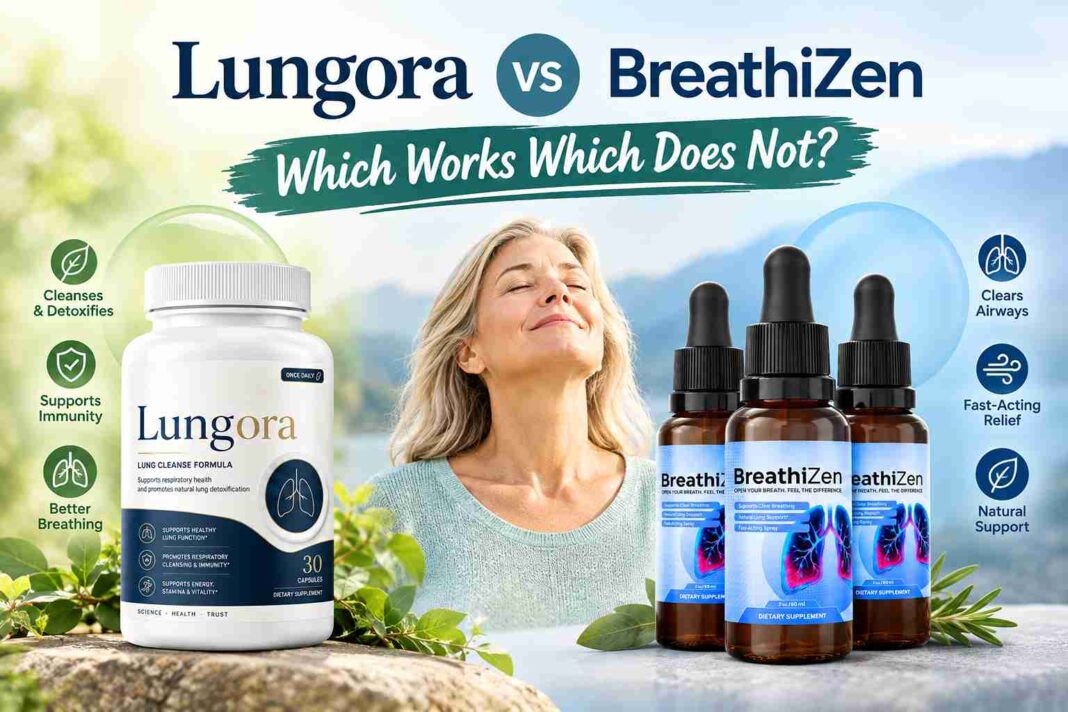
ToggleLungora vs BreathiZen: Ingredients, Doses, Price and Refunds Compared
By B Mishra | Facts checked: 29 October 2026 | US market, prices in USD
A desk-researched comparison of a once-daily capsule and a once-daily mouth spray, covering label doses, evidence, safety, real daily cost and refund terms.
Short answer: neither product has a published trial of its finished formula that we could find, so we cannot call either one the better lung supplement. The real differences are practical. Lungora’s supplied label shows every ingredient amount, but most of those ingredients are better known from joint, memory or antioxidant research than from breathing research. BreathiZen’s ingredients have more traditional airway use, but its label hides the individual amounts inside one 154 mg blend.
The cheaper way to try something is BreathiZen, which starts at $89 for one bottle. The easier label to check is Lungora’s, once you confirm which formula is actually on the bottle (see the notice below). If you have asthma, COPD, liver disease or take a blood thinner, speak to a pharmacist or doctor before either.
Affiliate disclosure: HealthyPa may earn a commission if you buy Lungora or BreathiZen through the links on this page, at no extra cost to you. Both products have an affiliate link, so neither is favoured commercially. This is an editorial desk review, not a personal-use test or medical endorsement. Read our affiliate disclosure and how we review supplements.
Read this first: Lungora’s formula is not consistent across sources
The Supplement Facts image supplied for this comparison lists glucosamine, ginkgo, turmeric, marigold, green tea and bamboo extracts, with every amount disclosed. The seller’s sales page we checked on 29 October 2026 instead names magnesium glycinate, alpha-lipoic acid, butcher’s broom, L-carnitine, turmeric and coenzyme Q10, and describes nerve, circulation and antioxidant support. We analyse the supplied label because it is the more detailed source, but we could not establish which formula ships today. Check the Supplement Facts on your bottle or the checkout page before you buy.
Lungora vs BreathiZen: Quick Facts
| Item | Lungora | BreathiZen |
|---|---|---|
| Format | Capsule (bovine gelatin), 30 per bottle | Liquid spray, 2 oz (60 mL) bottle |
| Label directions | 1 capsule daily with 8 oz of water | 4 sprays (0.60 mL) into the mouth or onto the tongue once daily |
| Disclosed amounts | All six actives, 445 mg combined per capsule | One proprietary blend of 154 mg; no individual amounts |
| Main ingredients | Glucosamine, ginkgo, turmeric, marigold, green tea, bamboo extracts | Mullein leaf, ginger root, organic lemon extracts |
| Finished-product trial found | None located | None located |
| Lowest advertised order | 2 bottles, $178 plus shipping | 1 bottle, $89 plus shipping |
| Best advertised unit price | 6 bottles for $294 ($49 each) | 6 bottles for $294 ($49 each) |
| Refund window | 60 days from purchase; return all bottles at your cost | 60 days from purchase; page says after at least 30 days of use; return terms not opened |
| Distributor named on label | Lungora, PO Box 12730, Ogden, UT 84412 | GEX Corp, Lakeland, FL 33804 |
Seller pages and labels checked 29 October 2026. Prices, bundles and terms can change. Taxes and any shipping charge on smaller orders are not included.
What Are Lungora and BreathiZen?
Both are US-marketed dietary supplements sold as lung or respiratory wellness products. Neither is a medicine, and both labels carry the standard statement that the product is not intended to diagnose, treat, cure or prevent any disease.
Lungora is a once-daily capsule. Its packaging calls it a “Lung Cleanse Formula” and says it supports respiratory health and “natural lung detoxification”. The seller’s sales page is labelled as an advertorial and targets adults over 50. Our separate Lungora review covers the single-product details, but it describes the formula on the seller’s page rather than the label image used here.
BreathiZen is a once-daily mouth spray. Its label says it helps promote clear breathing and respiratory function. Its sales page goes further, saying the product works “directly on the lungs” and relieves congestion. Those are seller claims. The label itself tells you to spray into the mouth, and we found no evidence that a swallowed herbal spray acts on lung tissue differently from any other oral supplement.
Formula and Dose Comparison
The two labels share no ingredients, so there is no shared-ingredient dose to compare. What we can compare is how much each label tells you, and how the disclosed amounts sit against research. All Lungora figures below come from the supplied label image. Percentages of marker compounds are our arithmetic from the label’s own standardisation statements.
Lungora: per capsule (supplied label)
| Ingredient and form | Label amount | What the amount means | Research context |
|---|---|---|---|
| D-glucosamine sulfate potassium chloride | 250 mg | Largest single active | Mainly studied for knee osteoarthritis, not breathing |
| Ginkgo biloba leaf extract (4:1) | 100 mg | About 400 mg of leaf by the stated ratio | Studied for memory and dementia; large studies have not shown benefit |
| Turmeric root extract (30:1) | 50 mg | About 1.5 g of root by the stated ratio; curcuminoid percentage not stated | Curcuminoid dose cannot be estimated |
| Marigold flower extract (5% lutein) | 25 mg | About 1.25 mg lutein | No breathing outcome located in this research |
| Green tea leaf extract (50% EGCG) | 15 mg | About 7.5 mg EGCG | Liver concerns relate to far higher EGCG intakes |
| Bamboo leaf extract (30:1, 70% silica) | 5 mg | About 3.5 mg silica | No breathing outcome located in this research |
Other ingredients on the label: gelatin (bovine) capsule, magnesium stearate, microcrystalline cellulose. Daily Values not established for any active.
BreathiZen: per serving of 4 sprays (0.60 mL)
| Ingredient and form | Label amount | What the amount means | Research context |
|---|---|---|---|
| Mullein (Verbascum thapsus) leaf extract 10:1 | Not disclosed | Part of a 154 mg blend with the two below | Clinical data lacking for any indication, per a professional natural-products monograph |
| Ginger (Zingiber officinale) root extract | Not disclosed | Part of the same 154 mg blend | One small asthma trial used 2 g per day |
| Organic lemon extract | Not disclosed | Part of the same 154 mg blend | No breathing outcome located in this research |
Other ingredients on the label: purified water, glycerin, natural flavors, citric acid, potassium sorbate, sodium benzoate. The ingredients are listed in blend order, which does not tell you their amounts.
The dose arithmetic. The ginger trial gave 1 g twice daily, or 2 g a day, for two months. Even if BreathiZen’s entire 154 mg blend were ginger, which it is not, that would be at most 7.7% of the trial amount (154 divided by 2,000). Extract strength and form differ between products, so this is a ceiling test, not a verdict. It does show that the trial result cannot be assumed to apply to this spray.
Label-transparency checklist
| Check | Lungora (supplied label) | BreathiZen |
|---|---|---|
| Every active amount shown | Yes | No, blend total only |
| Extract ratios or standardisation shown | Yes, for five of six | Mullein only (10:1) |
| Allergen or source statement for the actives | Not shown on the image; glucosamine source not stated | Not shown on the label |
| Seller page ingredients match the label | No, the page lists a different formula | No, the page names bromelain and Cordyceps, which are not on the label |
| Bottle count matches the sold supply | Yes, 30 capsules for 30 days | Unclear: label shows 100 servings, page says 30 days |
| Manufacturer named | No, distributor only | No, distributor only |
What Does the Evidence Support?
Finished products: we did not locate a published trial of either Lungora or BreathiZen. Our searches used web search aimed at PubMed and ClinicalTrials.gov rather than querying those registries directly, so this means “not found”, not “does not exist”. Product-name searches mostly returned sponsored or templated promotional pages, which we did not count as evidence.
Mullein: a professional natural-products monograph states that clinical trial data are lacking to recommend mullein for any indication. Its traditional use for coughs is real, but tradition is not a trial.
Ginger: the best airway-related human data we found is a randomized trial in 32 adults with mild-to-moderate uncontrolled asthma taking 1 g of ginger twice daily alongside usual treatment. The two primary measures did not change significantly. Some secondary symptom scores improved. That is a small, early signal in people with asthma, not evidence that a 154 mg blend helps healthy adults breathe better.
Lungora’s ingredients: ginkgo has been studied for memory, and Mayo Clinic notes large studies have not shown it helps. Glucosamine is mainly studied for knee osteoarthritis, and the Merck Manual notes limited evidence of benefit. We found no breathing-outcome evidence for the marigold, bamboo or low-dose green tea extracts, and turmeric’s amount of active curcuminoids is not stated. For a product named after the lungs, the supplied formula is a notable mismatch.
| Question | Lungora | BreathiZen |
|---|---|---|
| Is the finished formula tested? | None located | None located |
| Are ingredients relevant to breathing? | Few, and the amounts are small or unstated | More traditionally relevant (mullein, ginger), but amounts hidden |
| Can the label dose be compared with research? | Yes, and it mostly does not align | No, individual doses undisclosed |
| Overall evidence conclusion | Insufficient to support lung claims | Insufficient to support lung claims |
Claim Audit: What Each Seller Says and What We Found
| Product | Seller claim | Evidence found | HealthyPa assessment |
|---|---|---|---|
| Lungora | “Lung Cleanse Formula” and “natural lung detoxification” (packaging) | No evidence that any listed ingredient cleanses or detoxifies lungs | Unsupported. “Detox” is not a measurable outcome |
| Lungora | Supports healthy lung function (packaging, sales page) | No finished-product trial; ingredients mainly studied for other uses | Unsupported as a product claim |
| Lungora | Nerve, circulation and antioxidant support (sales page) | Describes ingredients that are not on the supplied label | Unresolved formula conflict |
| Lungora | “Thousands of adults” use it (sales page) | No verifiable count found | Unverified |
| BreathiZen | Works “directly on the lungs” and relieves congestion (sales page) | No trial; label directs the spray into the mouth | Unsupported |
| BreathiZen | Bromelain dissolves mucus; Cordyceps raises lung capacity (sales page) | Neither ingredient is on the label’s blend | Does not match the label |
| BreathiZen | “No significant side effects have been reported” (sales page) | No adverse-event data published | Cannot be verified |
| BreathiZen | Made in an FDA-registered facility (label) | Facility registration is not product approval; no certificate seen | Accurate wording at most, not a quality guarantee |
| BreathiZen | “While supplies last” with a countdown timer (sales page) | No stock information published | Urgency device, not evidence |
On the FDA point: the agency does not have authority to approve dietary supplements before they are sold, and facility seals should not be mistaken for safety or federal approval.
The BreathiZen sales page also contains text that appears to belong to a different product. Alongside the airway ingredients it describes a neuropathy formula called “Nervion” and fat-burning ingredients such as green coffee, chromium and L-theanine, none of which are on the BreathiZen label. We cannot say why. It is a reason to rely on the label rather than the page.
Safety and Interactions
Neither company publishes adverse-event data, so we cannot give a side-effect rate for either product. The cautions below come from the listed ingredients, not from product testing. Our general supplement safety guide explains how to check any label.
Lungora (supplied label)
Asthma: the Merck Manual notes some people with asthma have had flares with glucosamine, and high-dose glucosamine may interact with warfarin. That matters for a lung product.
Bleeding: Mayo Clinic warns ginkgo might raise bleeding risk with blood thinners. A 2008 review of controlled studies found little effect on clotting, but could not exclude rare individual events.
Liver: NIH LiverTox and Australia’s TGA describe rare liver injury linked to turmeric supplements. Green tea extract is a smaller issue at 7.5 mg EGCG; a US Pharmacopeia review tied liver cases to concentrated extracts.
Other: the capsule is bovine gelatin. The label does not state the glucosamine source, so ask the seller if you have a shellfish allergy.
BreathiZen
Hidden amounts: because individual doses are undisclosed, a pharmacist cannot fully check interactions for mullein, ginger or lemon extract.
The seller’s own advice: its page says to show the label to a doctor first if you are pregnant, nursing, under 18, or take medicines for asthma, COPD or high blood pressure.
Preservatives and sweeteners: the spray contains glycerin, potassium sorbate and sodium benzoate. Check these if you react to additives.
Stopping treatment: the page says some buyers were told they would need strong medication for life. Never stop prescribed treatment because of a supplement.
When not to self-treat. Sudden or severe breathlessness, chest pain, blue lips, confusion or coughing blood need urgent care. A cough, wheeze or tight chest that lasts more than a few weeks needs assessment. If you smoke or used to, our guide to lung health for smokers covers what has real evidence behind it. Both labels advise people with a medical condition, and pregnant or nursing mothers, to consult a physician first.
Real Cost, Bottle Duration and Refund Terms
Both sites advertise the same $49-a-bottle price for six bottles, so the real differences sit in smaller orders and in how long a bottle lasts. Here are the advertised US packages with our per-day calculation (total divided by the days of supply the seller states).
| Package | Total | Per bottle | Per day, as sold | Shipping |
|---|---|---|---|---|
| Lungora, 2 bottles (60 days) | $178 | $89 | $2.97 | Extra, amount not stated |
| Lungora, 3 bottles (90 days) | $216 | $72 | $2.40 | Free US shipping |
| Lungora, 6 bottles (180 days) | $294 | $49 | $1.63 | Free |
| BreathiZen, 1 bottle (30 days) | $89 | $89 | $2.97 | Extra, amount not stated |
| BreathiZen, 3 bottles (90 days) | $177 | $59 | $1.97 | Free US shipping |
| BreathiZen, 6 bottles (180 days) | $294 | $49 | $1.63 | Free |
Like for like. At three bottles BreathiZen is $39 cheaper ($216 minus $177). At six bottles the price is identical. At the entry level, BreathiZen is $89 against Lungora’s $178 minimum on the page we checked. We excluded strikethrough “original” prices and “you save” figures because we could not verify that anyone paid them. BreathiZen’s 3- and 6-bottle orders also include five digital “bonuses” with stated dollar values. We did not assign them any value, and several cover topics unrelated to breathing.
The BreathiZen bottle puzzle. The label says 100 servings per 2 oz bottle, and 60 mL divided by 0.6 mL does give 100. The sales page sells the same bottle as a 30-day supply. Both cannot be right for once-daily use. If the label is correct, one bottle lasts about 100 days and the real cost per serving is far lower:
| BreathiZen package | Per day as sold (30 days a bottle) | Per serving by label (100 servings a bottle) |
|---|---|---|
| 1 bottle, $89 | $2.97 | $0.89 |
| 3 bottles, $177 | $1.97 | $0.59 |
| 6 bottles, $294 | $1.63 | $0.49 |
We cannot resolve this from public information. Ask the seller how many days one bottle is meant to last before choosing a bundle. If the label is right, a single bottle outlasts the 60-day refund window.
Refund exposure. Lungora’s return policy is published and clear: you have 60 days from the purchase date, must contact support first, must return all bottles whether empty or not with the packing slip, and pay return shipping, which is not refunded. A six-bottle order is a 180-day supply but a 60-day window. BreathiZen’s page promises 60 days from purchase and says to contact support after at least 30 days of use. The full terms are hosted on a separate third-party domain that we could not open, so we treat them as unverified. Neither guarantee is evidence of effectiveness. We did not buy either product or test a return.
Seller Transparency and Customer Feedback
Lungora. The label names Lungora as distributor with a PO Box in Ogden, Utah, a phone number and a support email. The return policy sends bottles to a fulfilment address, also a PO Box. We could not identify the manufacturer or any manufacturing or testing certificate. The sales page is openly labelled an advertorial.
BreathiZen. The label names GEX Corp in Lakeland, Florida, and says “FDA registered facility”. The sales page has Brazilian-Portuguese site metadata and legal pages on a separate .com.br domain, and several look-alike BreathiZen sites appeared in search results under other domains. We did not verify those as authorized. Confirm the checkout domain and merchant before paying.
Customer feedback. We could not establish an independent, verifiable review base for either product, and so we give no star rating. BreathiZen’s page shows named five-star “Verified Purchase” testimonials, and the same page admits some names were changed. We treat them as seller marketing. Third-party “review” pages for both products that we found were sponsored or templated and often recycled the sales copy. A lack of findable reviews is not proof of a scam, and we have no evidence to call either seller fraudulent.
Which Should You Choose? A Practical Decision Guide
We do not name an overall winner, because the evidence does not support one. Here is how the verified differences map to different priorities.
| Your priority | Verified difference | Possible choice | Caveat |
|---|---|---|---|
| I want to check doses against research | Lungora shows six amounts; BreathiZen shows one blend total | Lungora, once the formula is confirmed | Visible doses are not proof of benefit, and most do not align with breathing research |
| I want the lowest cost to try | BreathiZen $89 for one bottle; Lungora $178 for two on the page checked | BreathiZen | Shipping on a single bottle is not stated, and bottle duration is unclear |
| I prefer not to swallow capsules | BreathiZen is a mouth spray | BreathiZen | No evidence that a spray works better than a capsule |
| I want clear refund steps | Lungora’s policy was read in full; BreathiZen’s was not accessible | Lungora | You pay return shipping and must return every bottle |
| I have asthma or COPD | Lungora’s label includes glucosamine; BreathiZen’s doses are hidden | Neither without clinician review | Neither replaces an inhaler or prescribed treatment |
| I take warfarin or another blood thinner | Glucosamine and ginkgo have bleeding-related cautions | Not Lungora without medical advice | BreathiZen cannot be fully assessed either |
| I want proven results | No finished-product trial for either | Neither | See a clinician for any ongoing breathing symptoms |
Pros and Cons
Lungora
Pros
- Every active amount shown on the supplied label
- Extract ratios and standardisation stated
- Return steps clearly published
- Bottle count matches the stated supply
Cons
- Seller page lists a different formula from the label
- Ingredients mostly studied for non-breathing uses
- Glucosamine and ginkgo cautions suit a lung product poorly
- $178 minimum on the page checked
- Buyer pays return shipping and returns all bottles
BreathiZen
Pros
- Ingredients with traditional airway use
- Lowest entry price at $89 for one bottle
- Cheaper than Lungora at three bottles
- Spray format for people who avoid capsules
Cons
- Individual doses hidden in a 154 mg blend
- Sales page ingredients and unrelated product text do not match the label
- Unresolved 30-day versus 100-serving mismatch
- Countdown and “while supplies last” urgency
- Refund terms on a domain we could not open
Lungora vs BreathiZen: Frequently Asked Questions
Is Lungora or BreathiZen better?
We could not find a verified basis to call either one better for breathing. Lungora is easier to assess because its supplied label lists every amount. BreathiZen is cheaper to try. Neither has a published finished-product trial.
Do Lungora or BreathiZen detox the lungs?
No evidence we found shows that either product cleanses or detoxifies the lungs. Lungora’s packaging uses the word detoxification, and BreathiZen’s page talks about eliminating toxins. Neither is a measured outcome. Stopping smoking and reducing exposure to polluted air have clearer roles.
Is BreathiZen FDA approved?
No. The FDA does not approve dietary supplements before sale. The BreathiZen label says it was made in an FDA-registered facility. That describes the factory’s registration, not an assessment of the product. The same applies to Lungora.
Can I use either with an inhaler or COPD or asthma medicine?
Ask your pharmacist or doctor first and take the Supplement Facts panel with you. Neither product should replace prescribed treatment. Lungora’s label formula contains glucosamine, which may worsen asthma in some people. BreathiZen’s amounts are hidden, which limits any check.
How long does a bottle last?
A Lungora bottle holds 30 capsules, so 30 days at one a day. BreathiZen’s label shows 100 servings of four sprays, but its sales page sells a bottle as 30 days. We could not reconcile the two, so ask the seller before buying a large bundle.
Which is cheaper per day?
As advertised, BreathiZen is cheaper at one bottle ($89 against Lungora’s $178 for two) and at three bottles ($177 against $216). At six bottles both cost $294, which is $1.63 a day. If BreathiZen’s label serving count is right, its real per-serving cost is lower still.
Are BreathiZen’s testimonials real?
We cannot verify them. The page uses named five-star testimonials and says some names were changed. Treat them as seller marketing, not independent review data.
Is BreathiZen or Lungora a scam?
We have no evidence for that word and do not use it. We do see concrete transparency problems: a formula conflict on Lungora’s sources, and hidden doses, mismatched page text and urgency tactics on BreathiZen’s. Verify the merchant and read the terms before paying.
Final Verdict: Lungora vs BreathiZen
The honest summary
There is no clear winner and, on current evidence, neither product earns a recommendation for breathing support. If you decide to try one anyway, choose on practical grounds. Pick Lungora if checking doses and getting clear return steps matter most, and first confirm the formula on the bottle. Pick BreathiZen if low entry cost and a spray format matter most, and ask the seller how long a bottle lasts.
Choose neither if you need a proven outcome, have a diagnosed lung condition, take anticoagulants, or have liver disease, unless a clinician has reviewed the label. Ongoing breathing problems need medical assessment, not a supplement.
What we could not verify: which Lungora formula ships today; BreathiZen’s actual days of supply per bottle; BreathiZen’s full return terms; the manufacturer of either product; any batch testing; and any independent customer review base. Read our editorial policy for how we handle gaps like these.
Sources and How This Comparison Was Researched
This is a desk review dated 29 October 2026. We read both sellers’ sales pages, Lungora’s return policy and the supplied Supplement Facts images for each product. We did not buy either product, commission laboratory tests, or test customer support or refunds. This comparison has not been medically peer reviewed. Product-name searches for a finished-product trial found none. Other affiliate and sponsored reviews were treated as leads, not proof.
- Lungora seller sales page: formula description, package prices and guarantee (checked 29 October 2026)
- Lungora return policy: 60-day window, return of all bottles, buyer-paid shipping
- BreathiZen seller sales page: claims, package prices, guarantee and FAQ (checked 29 October 2026)
- Drugs.com professional monograph: mullein, clinical data
- Low-dose oral ginger in 32 adults with uncontrolled asthma: randomized trial
- Mayo Clinic: ginkgo, evidence and safety
- Bone K. Ginkgo biloba and antiplatelet or anticoagulant drugs: review of evidence, 2008
- Merck Manual consumer version: glucosamine
- NIH LiverTox: turmeric
- Australia TGA: turmeric and curcumin, liver injury risk
- US Pharmacopeia systematic review: safety of green tea extracts
- Operation Supplement Safety: what GMP and FDA facility seals mean
Medical disclaimer: This comparison is general information, not diagnosis or treatment. Supplements can cause side effects and interact with medicines. Speak with a qualified healthcare professional before starting any supplement. Read our full medical disclaimer.
Affiliate disclosure: HealthyPa may earn a commission from qualifying purchases through links on this page, at no extra cost to you.
The information provided on HealthyPa.com is for educational and informational purposes only and is not intended as medical advice. The content on this website, including articles, reviews, and product recommendations, should not be used as a substitute for professional medical advice, diagnosis, or treatment.
Always seek the advice of your physician or other qualified health provider with any questions you may have regarding a medical condition or before starting any new supplement, diet, or exercise program. Never disregard professional medical advice or delay in seeking it because of something you have read on this website.
The statements regarding dietary supplements have not been evaluated by the Food and Drug Administration (FDA). These products are not intended to diagnose, treat, cure, or prevent any disease.
Individual results may vary. The testimonials and experiences shared on this website are individual cases and do not guarantee that you will achieve the same results.
If you are pregnant, nursing, taking medication, or have a medical condition, consult your healthcare provider before using any products reviewed or recommended on this site.
HealthyPa.com and its authors, contributors, and affiliated parties assume no responsibility for any consequences relating directly or indirectly to any action or inaction you take based on the information found on this website.
By using this website, you acknowledge and agree to this disclaimer.
HealthyPa.com is reader-supported. When you buy through links on our site, we may earn an affiliate commission at no additional cost to you. This helps us keep our content free and continue providing valuable health information. We only recommend products we genuinely believe in. Learn more in our full Affiliate Disclosure Policy.