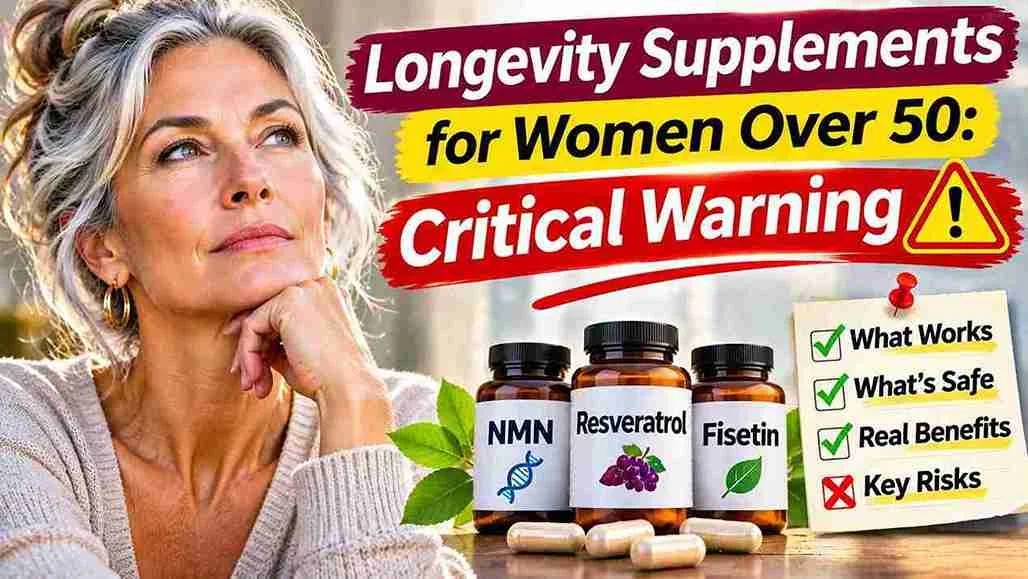
Short answer: For women over 50, the best-supported supplements are the basics: vitamin D, enough calcium and protein, and creatine alongside strength training. They target the two biggest ageing risks after menopause, bone loss and muscle loss. Newer longevity supplements such as NMN and Urolithin A have smaller, mixed evidence and come second, not first.
Affiliate disclosure: HealthyPa may earn a commission if you buy through our links, at no extra cost to you. Our score follows our published review method and the evidence described on this page.
| Supplement |
Evidence level |
Main purpose |
| Vitamin D |
Strong (NHS advice) |
Bone and muscle |
| Calcium (if diet is low) |
Strong |
Bone |
| Protein |
Strong |
Muscle |
| Creatine + strength training |
Good |
Strength and muscle |
| Omega-3 (if little oily fish) |
Moderate |
Heart |
| Urolithin A |
Early |
Muscle endurance |
| NMN |
Early / mixed |
NAD+ levels |
| Fisetin, GlyNAC |
Experimental |
Senescence, glutathione |
Why 50 Is a Turning Point
Falling oestrogen around menopause speeds up bone loss, and the NHS notes this is a major reason osteoporosis is more common in women. Muscle mass and strength also decline with age. Weak bones and weak muscles together drive falls and fractures, which are among the biggest threats to independence later in life. That’s why the strongest longevity strategy for women over 50 focuses on bone and muscle.
Tier 1: The Evidence-Backed Basics
Vitamin D
The NHS advises everyone in the UK to consider 10 micrograms (400 IU) of vitamin D a day in autumn and winter, and all year if you get little sun. It helps absorb calcium and supports muscle function. Don’t take more than 100 micrograms a day unless a doctor advises it.
Calcium
The UK recommendation is 700mg a day for adults; people with osteoporosis may be advised to take more by their doctor. Food is the preferred source: dairy, fortified plant milks, tinned fish with bones and leafy greens. Supplements make sense if your diet falls short, and very high-dose supplements without medical need aren’t advised.
Protein
Expert groups recommend that older adults eat around 1.0–1.2g of protein per kg of body weight daily, more than the standard adult figure. Spread it across meals. Protein powder is simply a convenient way to reach the target.
Creatine with strength training
Creatine monohydrate, usually 3–5g a day, is one of the most studied supplements. In older adults, combined with resistance training, it improves muscle strength more than training alone. It works best with exercise, not instead of it. People with kidney disease should check with their doctor first.
The real anti-ageing stack: strength training two or more days a week, enough protein, vitamin D and calcium. Nothing in a longevity bottle beats this foundation.
Tier 2: Useful for Some
Omega-3 fish oil may help heart health if you rarely eat oily fish. Magnesium supports bone and muscle, but most people get enough from food. Vitamin K2 is often paired with D3; evidence for bone benefit is mixed.
Tier 3: Newer Longevity Supplements
Urolithin A improved muscle endurance modestly in trials of middle-aged and older adults, including women. It’s the most relevant of the newer options for muscle. See our Urolithin A guide.
NMN raises blood NAD+ reliably, and a 2025 meta-analysis found small benefits for some muscle measures in older adults, but results are mixed. A small 2021 trial in postmenopausal women with prediabetes found improved muscle insulin sensitivity at 250mg a day. See NMN vs NR.
GlyNAC and fisetin remain experimental. The GlyNAC trials were small, and fisetin lacks published human anti-ageing results. A 2024 senolytic trial in postmenopausal women used dasatinib plus quercetin, a prescription combination, not a supplement.
Safety Checks Before You Start
- Tell your GP or pharmacist about all supplements, especially if you take blood thinners, thyroid, osteoporosis or blood pressure medicines.
- If you’re on HRT, supplements don’t change the need to follow your prescriber’s advice.
- Take calcium apart from thyroid medicine and some antibiotics.
- Ask about a bone density scan if you have risk factors such as early menopause, a previous fracture or long-term steroid use.
- Supplements don’t treat menopause symptoms; talk to your doctor about proven options.
A Simple Evidence-Ranked Plan
| Step |
What to do |
| 1 |
Strength train 2–3 times a week |
| 2 |
Hit protein targets; add powder if needed |
| 3 |
Vitamin D 10mcg daily (UK guidance) |
| 4 |
Check calcium intake; supplement only if low |
| 5 |
Consider creatine 3–5g with training |
| 6 |
Optional: Urolithin A or NMN as a monitored experiment |
If you try a newer supplement, run it for three months and judge it by function: strength, stamina, energy. A biological age test can give a baseline, but expect a margin of error.
Signs You May Be Short of Key Nutrients
Supplements matter most when your diet or lifestyle leaves a gap. Ask your GP about a blood test if any of these apply. Don’t self-diagnose a deficiency from symptoms alone.
| Nutrient |
More likely low if you… |
| Vitamin D |
Rarely go outside, cover skin, have darker skin, live in the UK in winter |
| Calcium |
Avoid dairy and fortified alternatives |
| Protein |
Eat small meals, skip meat/fish/beans, have a low appetite |
| Vitamin B12 |
Eat a vegan diet or take metformin or acid-reducing medicine |
| Iron |
Are still having heavy periods |
Strength Training: The Non-Supplement That Works Best
Resistance exercise is the single most effective way to slow muscle and bone loss after 50. The NHS advises adults to do strengthening activities that work all major muscle groups on at least two days a week. For bone, weight-bearing and impact exercise such as brisk walking, stair climbing and, if safe for you, jumping or skipping also help.
- Start with bodyweight squats, wall press-ups and step-ups.
- Progress to resistance bands or weights.
- Aim for 8–12 repetitions where the last few feel hard.
- Add balance work, such as standing on one leg, to reduce fall risk.
- If you have osteoporosis, ask a physiotherapist for a safe programme.
A Day of Protein: What It Looks Like
For a 70kg woman, 1.0–1.2g of protein per kg is about 70–85g a day. Spreading it evenly is thought to support muscle better than one large protein meal.
| Meal |
Example |
Approx. protein |
| Breakfast |
Greek yoghurt with oats and seeds |
~20g |
| Lunch |
Tuna or bean salad with wholegrain bread |
~25g |
| Snack |
Glass of milk or soya milk and a handful of nuts |
~12g |
| Dinner |
Chicken, tofu or lentils with vegetables |
~25g |
Monthly Cost of a Sensible Stack
The foundation is cheap. Vitamin D and creatine monohydrate typically cost a few pounds a month each. Protein powder, if needed, adds more. The newer longevity supplements cost far more:
| Supplement |
Approx. monthly cost (UK) |
| Vitamin D 10mcg |
Under £2 |
| Creatine monohydrate 3–5g |
~£5–£10 |
| Aeternum NMN 500mg capsules |
~£12 |
| Aeternum Urolithin A 500mg capsules |
~£25 |
Aeternum prices: UK display prices checked on 14 November 2026. Other figures are typical UK high-street ranges. Spending £25 a month on Urolithin A before you’ve sorted protein, vitamin D and strength training puts the money in the wrong order.
Supplements With Weak or No Evidence
Many products aimed at women over 50 promise more than research supports. Collagen has mixed evidence for skin and joints and adds protein, but isn’t a complete protein. Resveratrol showed early promise that hasn’t held up in human trials. Most “menopause blend” supplements combine low doses of many ingredients without trials of the formula itself. Read labels for exact doses and avoid proprietary blends.
When to See Your Doctor Instead
- Hot flushes, sleep problems or mood changes that affect daily life: HRT and other treatments are effective.
- A fracture from a minor fall.
- Unexplained weight loss, extreme tiredness or loss of strength.
- Joint pain or swelling.
- Before starting any supplement if you take regular medicines.
Frequently Asked Questions
What is the most important supplement for women over 50?
For most UK women, vitamin D, plus enough calcium and protein from diet.
Is creatine safe for women over 50?
It’s well studied and generally safe at 3–5g a day; check with a doctor if you have kidney problems.
Is NMN good for menopause?
There’s no evidence NMN treats menopause symptoms.
Should I take Urolithin A?
It’s optional. The evidence is early and best for muscle endurance.
HealthyPa’s Verdict : Longevity Supplements for Women Over 50
Build the foundation first: strength training, protein, vitamin D and calcium. If you want to try a newer longevity supplement, Urolithin A has the most relevant muscle data for women over 50.
Related HealthyPa longevity guides
Medical disclaimer: This article is general information and does not replace medical advice, diagnosis or treatment. Supplements can cause side effects and interact with medicines. Speak with a qualified healthcare professional about your circumstances.