
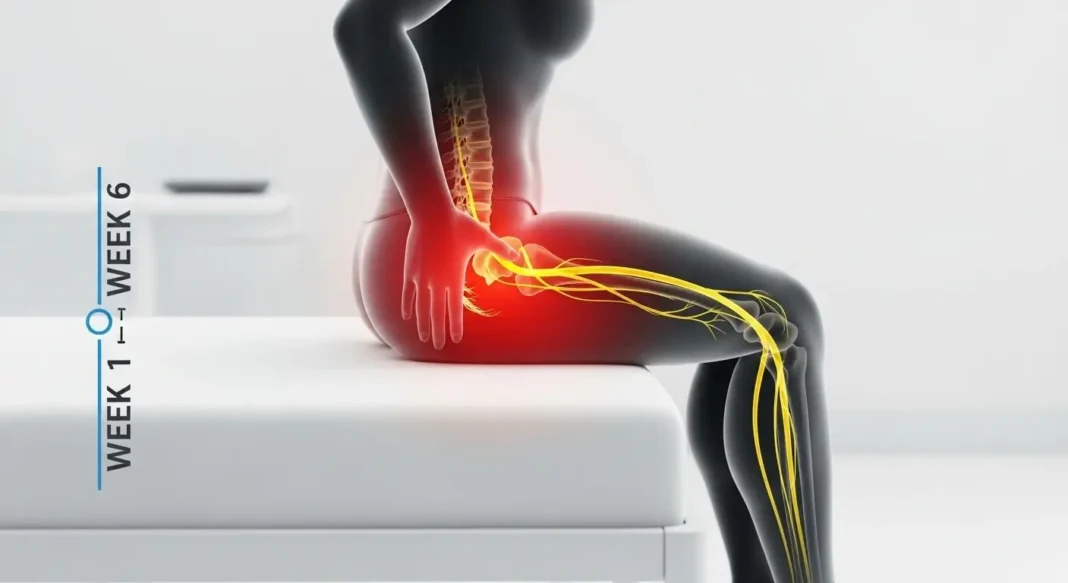


If you’re reading this while shifting uncomfortably in your chair, trying to find that one position where your leg doesn’t feel like it’s on fire, you’re not alone. Sciatic nerve pain affects millions of people worldwide, and one of the most pressing questions on everyone’s mind is simple: when will this finally end?
I’ve spent years working with patients experiencing sciatica, and I can tell you that the answer isn’t always straightforward. But here’s what I can promise – by the end of this article, you’ll have a much clearer understanding of what to expect, why recovery times vary so dramatically, and most importantly, what you can actually do to speed up your healing process.

Relieve Sciatica FASTER 🔥 — Tap Here to Learn the REAL Fix!
Understanding the Basics: What Actually Is Sciatica?
Before we dive into timelines, let’s quickly clarify what we’re dealing with. Sciatica isn’t actually a condition itself – it’s a symptom. The sciatic nerve, which runs from your lower back down through your hips and buttocks and down each leg, is the longest and thickest nerve in your body. When something irritates or compresses this nerve, you get that characteristic pain that can range from a mild ache to an excruciating burning sensation.
The most common culprits behind sciatic nerve pain include herniated discs (responsible for about 90% of cases according to research published in the European Spine Journal), spinal stenosis, piriformis syndrome, or even something as simple as sitting on a wallet in your back pocket for too long. Yes, that’s actually a thing – we call it “wallet sciatica” in clinical settings, though the proper term is piriformis syndrome.
The Timeline Question: Breaking Down Recovery Periods
Acute Sciatica (4-6 Weeks)
For most people experiencing their first bout of sciatica, here’s some encouraging news: approximately 80-90% of acute sciatica cases resolve within 4 to 6 weeks with conservative treatment. This statistic comes from multiple studies, including comprehensive research published in the New England Journal of Medicine.
During this acute phase, the pain typically follows a predictable pattern. Week one is often the worst – that’s when inflammation is at its peak. By week two, many people notice the pain becoming more manageable, especially with proper treatment. Weeks three and four usually bring significant improvement, and by weeks five and six, most individuals are back to their normal activities, albeit sometimes with lingering mild discomfort.
I remember working with Sarah, a 42-year-old teacher who developed acute sciatica after helping to move classroom furniture. She was convinced she’d never be able to stand in front of her class again. But with a combination of gentle stretching, anti-inflammatory medication, and modified activities, she was back teaching (with a tall stool for support) within three weeks and completely pain-free by week five.
Subacute Sciatica (6-12 Weeks)
When sciatic nerve pain persists beyond six weeks but hasn’t quite hit the three-month mark, we enter what medical professionals call the subacute phase. This affects roughly 20-30% of sciatica sufferers, and it’s often where people start to worry that something more serious is going on.
During this period, the body is still actively trying to heal, but progress might feel frustratingly slow. You might have good days and bad days – what we call a “two steps forward, one step back” pattern. This is actually normal and doesn’t mean you’re not healing. The nerve tissue itself heals slowly, at a rate of about 1-2 millimeters per day under optimal conditions.
Research from the Spine Journal indicates that patients in this subacute phase who engage in structured physical therapy programs have a 70% better outcome than those who remain sedentary. The key here is finding that sweet spot between rest and activity – too much of either can slow your recovery.
Chronic Sciatica (Beyond 12 Weeks)
When sciatic pain persists beyond three months, it’s classified as chronic. This happens to approximately 10-20% of people with sciatica, and yes, it can be discouraging. But chronic doesn’t mean permanent – it just means we need to adjust our approach.
Chronic sciatica often involves not just the original nerve irritation but also secondary factors like muscle weakness, altered movement patterns, and sometimes psychological factors like fear of movement (kinesiophobia). A 2020 study in Pain Medicine found that patients with chronic sciatica who participated in multidisciplinary treatment programs – combining physical therapy, psychological support, and medical management – showed significant improvement even after months or years of pain.
Factors That Influence Recovery Time
Age and Overall Health
Let’s be honest here – if you’re 25 and otherwise healthy, you’re likely to bounce back faster than someone who’s 65 with multiple health conditions. It’s not fair, but it’s biology. Younger tissues heal faster, and younger bodies generally have better circulation and less degenerative change in the spine.
However, I’ve seen plenty of motivated 70-year-olds recover faster than sedentary 30-year-olds. Your overall fitness level, flexibility, and core strength play huge roles in recovery speed. A study in the Archives of Physical Medicine and Rehabilitation found that people with stronger core muscles before developing sciatica recovered on average 2.5 weeks faster than those with weak cores.
The Underlying Cause
Not all sciatica is created equal. A simple muscle spasm causing nerve irritation might resolve in days, while a large disc herniation could take months. Here’s a rough breakdown of recovery times by cause:
- Muscle-related (piriformis syndrome): 2-4 weeks with proper treatment
- Disc bulge or small herniation: 6-12 weeks
- Large disc herniation: 3-6 months (though surgery might be considered if conservative treatment fails)
- Spinal stenosis: Often requires ongoing management rather than complete resolution
- Pregnancy-related sciatica: Usually resolves within 3 months postpartum
Your Response to Initial Treatment
How quickly you respond to initial treatment is actually one of the best predictors of overall recovery time. If you notice even slight improvement within the first two weeks of treatment, that’s a very good sign. Research published in the British Medical Journal found that patients who showed any improvement in the first two weeks had an 85% chance of full recovery within three months.
Conversely, if you’ve tried conservative treatment for 6-8 weeks with absolutely no improvement, it might be time to reassess the diagnosis or consider more advanced interventions.
Treatment Approaches and Their Impact on Recovery
Conservative Treatment: The First Line of Defense
The good news is that most cases of sciatica respond well to conservative treatment. This typically includes:
Controlled Movement and Exercise: Contrary to old-school advice about strict bed rest, we now know that gentle movement speeds recovery. A landmark study in the Annals of Internal Medicine showed that people who maintained modified activity recovered 30% faster than those on bed rest. Start with simple walking – even just 10 minutes every few hours can help.
Physical Therapy: This is where the magic happens for many people. A good physical therapist won’t just give you generic exercises; they’ll assess your specific movement patterns and create a tailored program. McKenzie exercises, neural flossing, and core stabilization work have all shown significant benefits in clinical trials.
Medication Management: Over-the-counter NSAIDs like ibuprofen can help control inflammation in the acute phase. Some people benefit from muscle relaxants or nerve pain medications like gabapentin. Always work with your healthcare provider to find the right combination for you.
Hot and Cold Therapy: Ice for the first 48-72 hours to control inflammation, then alternating heat and ice. It’s simple but effective. A 2019 study found that people who used regular hot/cold therapy reported 40% better pain control than those who didn’t.
When Conservative Treatment Isn’t Enough
Sometimes, despite our best efforts, conservative treatment doesn’t cut it. Red flags that might indicate you need more aggressive intervention include:
- Progressive weakness in the leg
- Loss of bowel or bladder control (this is a medical emergency – seek immediate care)
- Pain that’s getting worse despite treatment
- Complete numbness in the saddle area
Epidural Steroid Injections: These can provide significant relief for some people, especially when inflammation is the primary problem. Studies show mixed results, but about 50-60% of patients experience meaningful improvement. The effects typically last 3-6 months, which can buy time for natural healing to occur.
Surgery: Only about 5-10% of sciatica cases require surgery, but when it’s needed, it can be life-changing. Microdiscectomy for herniated discs has a success rate of about 85-90% according to long-term studies. Recovery from surgery typically takes 6-12 weeks, though some people feel immediate relief of leg pain.
STOP the Pain 📉 — Discover How Long Sciatica Really Lasts!
Real-World Recovery Stories
Let me share a few cases that illustrate the varied nature of sciatica recovery:
Mark, 38, Construction Worker: Developed severe sciatica from a herniated disc. Tried conservative treatment for 8 weeks with minimal improvement. Opted for microdiscectomy surgery. Was back to light duty work in 6 weeks, full construction work at 12 weeks. Total time from onset to full recovery: 5 months.
Jennifer, 45, Office Manager: Piriformis syndrome from prolonged sitting. Started physical therapy immediately, modified her workstation, began a regular stretching routine. Significant improvement by week 2, completely pain-free by week 4. Total recovery time: 4 weeks.
Robert, 62, Retired: Spinal stenosis causing chronic sciatica. Tried conservative treatment for 3 months with limited success. Started a combination of epidural injections every 3 months and intensive physical therapy. While not completely pain-free, he’s able to golf and travel with minimal discomfort. Ongoing management rather than complete resolution.
The Psychological Component: An Often Overlooked Factor
Here’s something that doesn’t get talked about enough – your mental state significantly impacts how long sciatic nerve pain lasts. Catastrophic thinking (“I’ll never get better”), fear of movement, and depression can all slow recovery. A fascinating study in the Journal of Pain found that patients who received cognitive behavioral therapy alongside physical treatment recovered on average 3 weeks faster than those who received physical treatment alone.
This doesn’t mean the pain is “in your head” – it’s absolutely real. But our brains and nervous systems are interconnected in complex ways. Stress increases muscle tension, which can worsen nerve compression. Anxiety heightens pain perception. Depression reduces motivation to do the exercises that could help.
Practical Steps to Speed Recovery
Based on current research and clinical experience, here are evidence-based strategies to potentially shorten your recovery time:
Week 1-2: Acute Management
- Apply ice for 20 minutes every 2-3 hours
- Take anti-inflammatories as directed by your healthcare provider
- Maintain gentle movement – avoid prolonged sitting or lying down
- Sleep with a pillow between your knees if you’re a side sleeper
Week 3-4: Building Movement
- Start specific stretching exercises (piriformis stretch, knee-to-chest, neural flossing)
- Begin walking program – aim for 20-30 minutes daily
- Consider starting physical therapy if not already begun
- Evaluate your workspace ergonomics
Week 5-6: Strengthening Phase
- Add core strengthening exercises
- Increase walking duration and pace
- Return to normal activities as tolerated
- Address any compensatory movement patterns
Beyond 6 Weeks
- Continue with structured exercise program
- Consider additional interventions if progress has plateaued
- Address lifestyle factors (weight, smoking, stress)
- Maintain long-term spine health practices
Prevention: Keeping Sciatica from Returning
Once you’ve recovered, the last thing you want is a recurrence. Unfortunately, about 30% of people who experience sciatica will have another episode within a year. But there’s plenty you can do to stack the odds in your favor:
Regular exercise, particularly activities that strengthen your core and improve flexibility, is your best defense. A long-term study in Spine found that people who exercised regularly had 60% fewer recurrences. Maintaining a healthy weight reduces stress on your spine. If you smoke, quitting improves disc health by increasing blood flow and oxygen delivery to spinal tissues.
Pay attention to your posture and body mechanics. That means lifting with your legs, not twisting while lifting, and taking regular breaks if you sit for long periods. Consider investing in ergonomic furniture if you work at a desk. These might seem like small things, but they add up over time.
The Bottom Line: Your Recovery Timeline
So, how long does sciatic nerve pain last? For most people, the answer is 4-6 weeks with appropriate treatment. But as we’ve seen, numerous factors can influence this timeline. Your age, overall health, the underlying cause, and how proactively you approach treatment all play crucial roles.
The most important thing to remember is that the vast majority of people with sciatica do recover fully. Yes, it might take longer than you’d like. Yes, there might be setbacks along the way. But with patience, appropriate treatment, and a commitment to your recovery, you can get back to living your life without that constant reminder shooting down your leg.
If you’re currently dealing with sciatica, don’t lose hope. Take it one day at a time, celebrate small improvements, and remember that healing is rarely linear. Work closely with your healthcare team, stay as active as safely possible, and trust in your body’s remarkable ability to heal.
Whether your journey to recovery takes a few weeks or a few months, know that you’re not alone in this. Millions of people have walked this path before you and come out the other side. With the right approach and mindset, you will too. The question isn’t if you’ll recover from sciatic nerve pain, but when – and now you have a much better idea of what to expect along the way.
End Your Sciatic Nerve PAIN Today ⚡ — Get the Full Breakdown!
The information provided on HealthyPa.com is for educational and informational purposes only and is not intended as medical advice. The content on this website, including articles, reviews, and product recommendations, should not be used as a substitute for professional medical advice, diagnosis, or treatment.
Always seek the advice of your physician or other qualified health provider with any questions you may have regarding a medical condition or before starting any new supplement, diet, or exercise program. Never disregard professional medical advice or delay in seeking it because of something you have read on this website.
The statements regarding dietary supplements have not been evaluated by the Food and Drug Administration (FDA). These products are not intended to diagnose, treat, cure, or prevent any disease.
Individual results may vary. The testimonials and experiences shared on this website are individual cases and do not guarantee that you will achieve the same results.
If you are pregnant, nursing, taking medication, or have a medical condition, consult your healthcare provider before using any products reviewed or recommended on this site.
HealthyPa.com and its authors, contributors, and affiliated parties assume no responsibility for any consequences relating directly or indirectly to any action or inaction you take based on the information found on this website.
By using this website, you acknowledge and agree to this disclaimer.
HealthyPa.com is reader-supported. When you buy through links on our site, we may earn an affiliate commission at no additional cost to you. This helps us keep our content free and continue providing valuable health information. We only recommend products we genuinely believe in. Learn more in our full Affiliate Disclosure Policy.
Excellent information!